


Growth Marketing
I've sat through the same TikTok Shop meeting more times than I can count.
A brand sends out 300 samples. Around 60 or 70 videos come back. A handful actually sell something, and the Shop does maybe $40K in a month. Then someone at the table says it out loud: "Imagine if we sent 1,000."
Nobody in the room can tell you which of those 60 videos did the selling. Nobody knows where the viewers went after they watched. But the sample budget doubles anyway, and so does the GMV Max spend.
Here's my honest take after watching a lot of brands go through this. When a TikTok Shop program stalls, the fix is almost never more money or more boxes. It's something upstream. Usually the creators, or what the videos are actually answering, or the listing the viewer lands on. Sometimes all three. This is what I'd look at first, in this order, before you approve another dollar.
All
orders on promoted products are credited to a running Product GMV Max campaign, paid and organic
1 day
GMV Max counts same-day orders on a one-day attribution window
4
questions your team should answer before you add samples or spend
More Samples Is Not a Strategy
GMV Max is hungry. You give it products and a return target, and it goes looking for videos and placements. TikTok's own documentation says it uses all available creative assets, including authorized affiliate videos featuring your products, across the feed, search and the Shop Tab.
That's the easy part. What it can't do is make a weak video explain why someone should buy. If the creative doesn't answer a real buying question, the algorithm just finds more people who won't buy. Spending more speeds that up. It doesn't fix it.
So before the media, look at the three things that feed it: the people making your content, what that content answers, and the listing it sends people to.
1. Build Creators, Don't Just Ship to Them
Someone who runs TikTok Shop for a growing agency told me something I keep coming back to: nurturing affiliate relationships is not optional. The creators who actually move product post about it again and again, almost like a series, where each video shows the product solving a real problem in their actual day.
One post is a sample that got opened. Five posts over two months is a creator who adopted the product. That's the difference you're looking for.
I've seen this pattern at brands with hundreds of thousands of affiliates. The creators who matter usually aren't the famous ones. They're the micro creators who keep posting because they genuinely use the thing every day.
A 40K-follower creator who actually hauls groceries up three flights of stairs will outsell a 2M-follower creator holding your bag for four seconds.
Pick creators on fit, not just past GMV
Historical GMV is a fine filter. It isn't the answer. The two questions that matter more:
- Can this creator demonstrate your product naturally, inside their real routine?
- Are the people watching them the people who would actually buy it?
Support them like partners
Give creators accurate product information. Forward them the questions coming into your customer support inbox, which is honestly the best creative brief you own and the one nobody reads. Tell them which angles are working.
What you don't do is write their script. The second a creator sounds like your product page, the comments will call it out and the video dies.
Repeat content beats duplicate content
This is the distinction I'd want every affiliate manager to understand.
| Repeat content (useful) | Duplicate content (useless) | |
|---|---|---|
| What it looks like | A creator's first video loads a foldable tote with groceries. A few weeks later, a follow-up answers a comment: does it fit in a car trunk? | The same opening line filmed in three different rooms |
| What the viewer learns | Two videos, two different buying questions answered | Nothing new after the first video |
| What the algorithm sees | A fresh, relevant reason to buy | A near-identical asset it has already tested |
Seed what you can actually nurture
Every sample has a product cost and a handling cost. But the real cost is that every creator you seed is someone your team now has to follow up with. If your team can meaningfully support 25 creators, seeding 300 doesn't get you 12 times the result. It gets you 275 orphaned relationships and a lot of your product listed on Facebook Marketplace.
📋
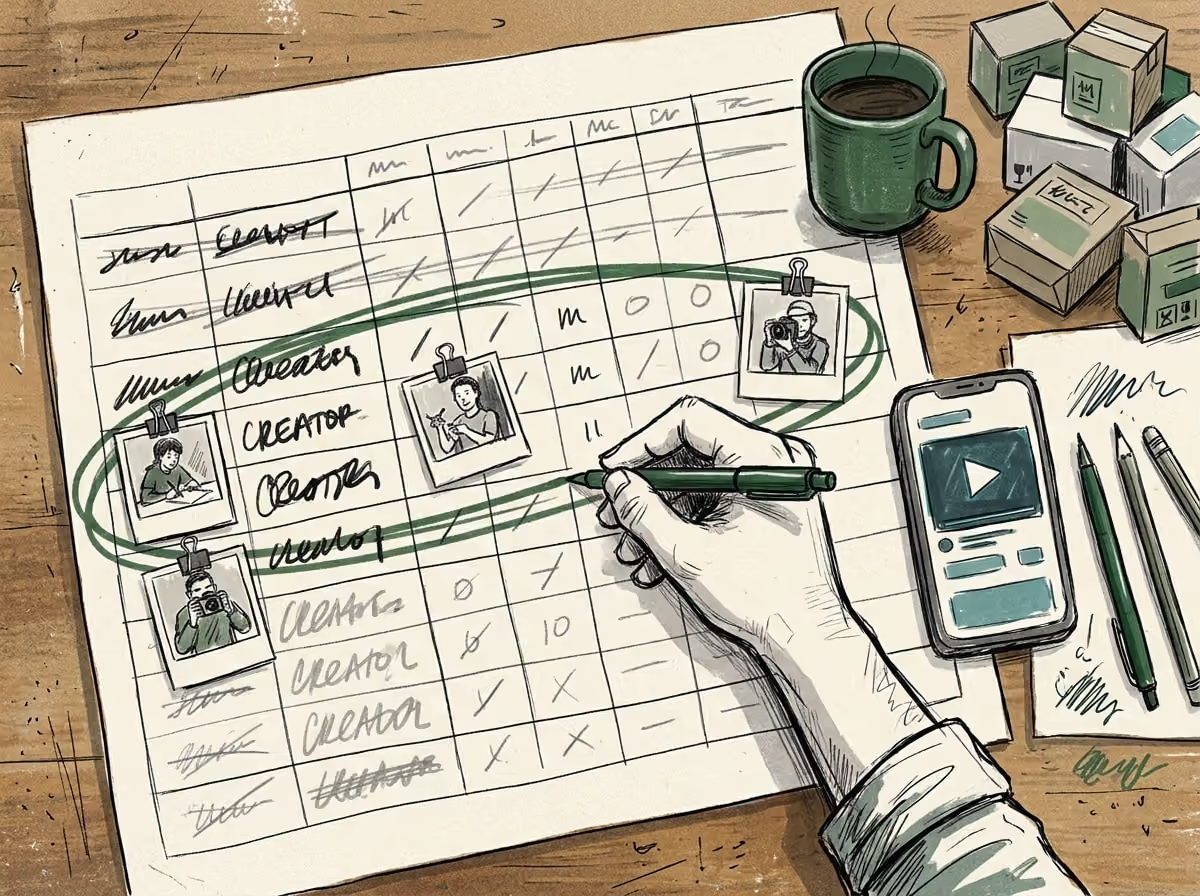
Do this tonight: open a spreadsheet with one row per creator you've already seeded. Add four columns: the use case they're credible on, what they've already posted, the questions showing up in their comments, and the one specific next video you'd ask them for. Twenty minutes in, you'll see which relationships have a next step and which ones were just a shipment.
2. Let Search Tell You What the Next Video Should Answer
Once you know who's making content, the next question is what that content should answer. TikTok search is the cheat code here, and almost nobody uses it.
📌 Did You Know
TikTok's Creator Search Insights shows what people are actively searching for in the app, and it includes a content gap filter that surfaces topics with high search interest but relatively few videos covering them. You can open it by searching "Creator Search Insights" in the app or from Creator Tools in settings.
A quick walkthrough of Creator Search Insights. Start with the content gap filter, then look for questions your product can honestly answer.
Treat it as a research input, not a guarantee. Demand with no content doesn't mean orders will show up. But it's the best free signal you have for what to make next.
The process is simple:
- Start with a single product use case.
- Look at what people search around it, and which videos already exist.
- Pick the question your product can honestly answer.
- Brief a creator to make that answer impossible to miss.
Nine times out of ten, that same search will also show you something missing from your product listing.
💡
The judgment call is fit. A popular search is worthless if your product can't credibly solve it. And a creator reading keywords into the camera is worse than no video at all. Search tells you what to answer. The creator decides how to say it.
3. The Video Made a Promise. Does the Listing Keep It?
Before you blame the content for weak results, walk the path a shopper takes after the video ends. I do this with every brand I look at, and it's shocking how often the answer is "oh."
- Stock: is the product actually in stock right now?
- Explanation: does the listing explain what the video just promised, or does the viewer land on three photos and a size chart?
- Delivery: is the shipping promise realistic for what your fulfillment partner can do this week?
- Reviews: when did anyone on the team last read the reviews and complaints?
Fulfillment problems and unanswered complaints hurt twice. The buyer has a bad experience, and your shop health score takes a hit, which can limit the programs and tools you're even eligible to use. I've seen a great product sit on the sidelines inside the Shop because of operational issues, and no amount of content could fix that until the operations got cleaned up.
The same logic applies off TikTok. If you've read our breakdown of the landing pages that are quietly printing money on Google and Meta, the principle is identical: the page has to finish the job the ad started.
Category rank is a diagnostic, not a goal
Look at where your product ranks versus the listings around it, and use the comparison to find confusing copy or a use case you never explain. And please don't pick the wrong category just to rank higher. Being number two somewhere nobody shops is worth exactly nothing.
🔍
Try this: pick one product. Watch the best creator video about it, then open the listing and ask what a shopper would still be unsure of. That gap is your next fix, and it's a lot cheaper than another round of samples.

4. Feed GMV Max, Then Read the Number Honestly
Now the media side. It's where most brands start, and where they should actually end.
Think of GMV Max as a cookie monster that eats videos. It wants volume. But a thousand near-identical videos get you a thousand near-identical results. So the question for every new piece of content is whether it adds a different, relevant reason to buy. It's the same problem I wrote about in why making more ads than ever can make performance worse, just on a different platform.
Your media buyer needs to know which videos are actually authorized for ads (check, don't assume, because plenty of creator posts aren't) and what's already been tested. That information then has to flow back to whoever is briefing creators. It's a loop. Most brands run it as a drop-off.
Why the GMV Max ROI isn't your profit
This part matters more than anything else in the article. TikTok states that while a Product GMV Max campaign is running, all paid and organic orders for the promoted products are attributed to GMV Max. That includes affiliate orders and orders from people who never saw an ad.
That's how the product works, and it's fine as long as you know it. It means the ROI on your dashboard is not an incremental return on ad spend, and it's definitely not profit. Do the math yourself:
| Line item | Example (monthly) |
|---|---|
| GMV attributed to GMV Max | $60,000 |
| Minus ad spend | − $15,000 |
| Minus affiliate commissions | − $7,200 |
| Minus product, fulfillment and platform fees | − $27,000 |
| What you actually kept | $10,800 |
The example numbers are illustrative, not a benchmark. The point is the structure. Then ask the harder question: does that number hold as spend goes up, or are you just paying to re-buy orders you were already getting? If you want the broader context on how ad platforms reward variety now, our piece on what Meta's algorithm actually rewards covers the same dynamic from the Meta side.
📌 Did You Know
GMV Max reporting calculates GMV for same-day orders on a one-day attribution window, while tools like GA4 usually look at much longer windows across every channel. Don't try to reconcile the two to the penny. Decide which business number you trust, and judge spend against that.
What This Looks Like in the Right Order
The clearest example I've come across was a foldable rolling tote brand that a TikTok Shop team I know took over. Great product, broken plumbing. The shop had a low health score that was restricting its affiliate tools and its access to GMV Max, with visibility and fulfillment problems stacked on top.
The sequence was exactly the one in this article:
- Fix the operations first.
- Rebuild the affiliate program around creators who would post repeatedly.
- Feed that content with what people were actually searching for.
- Only then turn GMV Max on.
Once the affiliate side was healthy, there was finally enough creative for the campaigns to hit their spend targets. GMV was reportedly up 124% in the first 90 days, and the newest product launch climbed to number two in its category in under 30 days, with most of that GMV coming through affiliates.
I want to be honest about what that proves. A before-and-after doesn't tell you which lever did what. But the order of operations is the lesson, and I'd follow it every time.

Four Questions Before You Spend Another Dollar
Back to that meeting. Before anyone approves more samples or more GMV Max budget, make the team answer these:
| Question | Why it matters |
|---|---|
| Which creator we've already seeded has a credible next video to make? | Tells you whether you need more creators or better follow-up |
| Which buying question should the next piece of content answer? | Stops you from making duplicate content |
| What would a shopper still be unsure of after opening the listing? | Finds the leak between the video and the sale |
| What business number tells us this spend was worth it? | Separates real profit from attributed GMV |
If you can answer all four, spend. If you can't, the money is just going to buy you more of whatever you already have.
✅
Start here: build the creator sheet tonight. It will tell you more about your TikTok Shop program than the last three weeks of dashboards did.
TikTok Shop rewards brands that do the boring, upstream work: real relationships with a smaller group of creators, content that answers real questions, listings that keep the video's promise, and honest math on what the spend is actually buying. Do those things in that order, and more samples and more budget start to make sense. Skip them, and you're just paying to make the same meeting happen again next quarter.
